| Category | Details |
|---|---|
| What Happened | A 7.8-magnitude earthquake struck northern Venezuela, causing widespread building collapses in the capital Caracas and surrounding cities. |
| When | June 24, 2026 — 14:37 local time (18:37 UTC) |
| Where | Epicenter approximately 15 km northeast of Caracas, Venezuela, near the coastal town of La Guaira |
| Who | National Civil Protection Agency, Venezuelan armed forces, international search-and-rescue teams, affected residents of Caracas and Miranda state |
| Why It Matters | The quake struck a densely populated urban area with aging infrastructure, leaving thousands displaced and straining Venezuela’s already limited emergency response capacity. |
| Source | United States Geological Survey (USGS), Venezuelan Foundation for Seismological Research (FUNVISIS) |
Powerful Earthquake Rocks Caracas, Collapsing Buildings and Trapping Residents
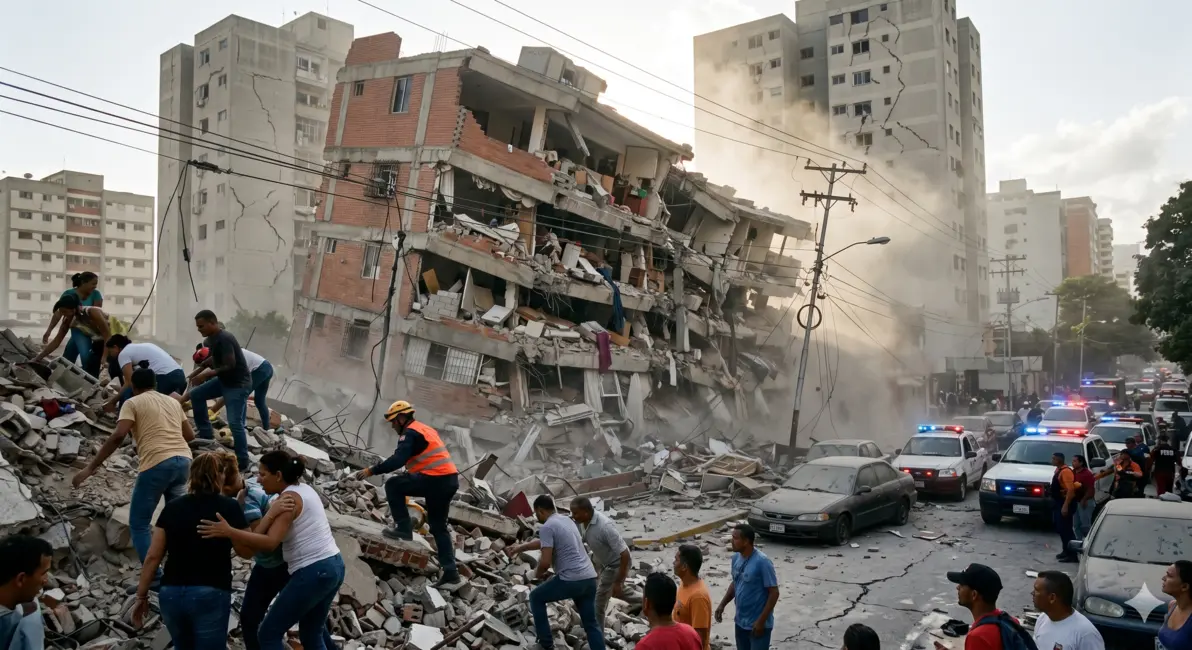
A powerful earthquake struck the Venezuelan capital on the afternoon of June 24, 2026, sending shockwaves through Caracas and its surrounding metropolitan area. The Venezuela earthquake June 2026, recorded at magnitude 7.8 by the United States Geological Survey, caused multiple buildings to collapse, trapping dozens of people under rubble and triggering a large-scale emergency response. Witnesses reported panic in the streets as older structures in the city centre and residential neighbourhoods buckled under the force of the quake. The event has placed immense strain on the country’s emergency services, which were already operating under challenging conditions due to ongoing economic difficulties. As aftershocks continue to rattle the region, officials are racing against time to locate survivors and assess the full extent of the damage across Caracas and the neighbouring state of La Guaira.
Seismic History and Regional Vulnerability
Venezuela sits along the southern edge of the Caribbean Plate, a tectonically active zone where the Caribbean and South American plates grind past each other. This boundary produces frequent seismic activity, though earthquakes of this magnitude are rare in the country’s modern history. Caracas last experienced a devastating quake in 1967, when a 6.5-magnitude event killed more than 200 people and caused extensive damage to the city’s older buildings.
In the decades since that disaster, construction codes were updated, but enforcement has been inconsistent. Many residential and commercial buildings in Caracas date from the 1970s and 1980s and were not designed to withstand ground shaking of the intensity seen in this event. The current Venezuela earthquake June 2026 has exposed these longstanding vulnerabilities. Experts have warned for years that a major quake near Caracas could be catastrophic, and this event has tragically confirmed those predictions. The situation is compounded by the country’s deep economic crisis, which has left public infrastructure poorly maintained and reduced the resources available for disaster preparedness and response.
What Happened — Key Developments
The Moment the Ground Shook
At 2:37 p.m. local time, a sudden jolt sent tremors across the Caracas metropolitan area. The shaking lasted approximately 45 seconds, according to seismic instruments, and was felt as far away as Maracay, Valencia, and even parts of eastern Colombia. The epicentre was located 15 kilometres northeast of Caracas, beneath the coastal municipality of La Guaira, at a depth of 12 kilometres — a shallow depth that amplified the surface shaking. The USGS initially reported the magnitude at 7.8, later confirming it after reviewing data from regional monitoring stations. FUNVISIS, Venezuela’s seismological agency, recorded multiple aftershocks within the first two hours, the strongest of which registered at magnitude 5.3.
Building Collapses and Rescue Operations
The most visible damage occurred in central and western Caracas, where at least six structures partially or fully collapsed. A seven-storey apartment building in the El Paraíso district folded onto itself, trapping an unknown number of residents. In the downtown area near Plaza Bolívar, a commercial building with retail shops and offices suffered a catastrophic structural failure, sending debris into the street. Emergency crews, including teams from the Venezuelan Civil Protection agency and the national fire department, were deployed within minutes. Neighbours and bystanders joined the effort, digging through rubble by hand in the first critical hours before heavy equipment arrived. Authorities have confirmed at least 47 deaths so far, with more than 320 injured and dozens still unaccounted for. These numbers are expected to rise as search operations continue.
Official Response and International Aid
Venezuelan President Nicolás Maduro addressed the nation in a televised broadcast, declaring a state of emergency for the Capital District and Miranda state. He called on the armed forces to support rescue efforts and urged citizens to remain calm. Several neighbouring countries, including Colombia, Brazil, and Mexico, have offered humanitarian assistance. The United Nations has also mobilised a disaster assessment team. However, the logistical challenges of delivering aid are significant. Caracas has faced chronic fuel shortages, electricity grid instability, and limited medical supplies — all of which are hampering the speed and scale of the response. Hospitals in the affected areas have been overwhelmed, with reports of patients being treated in parking lots and corridors due to a lack of available beds.
Key Points
- A 7.8-magnitude earthquake struck northern Venezuela on June 24, 2026, with its epicentre located 15 kilometres northeast of Caracas near La Guaira.
- At least six buildings collapsed in Caracas, including residential and commercial structures, leaving 47 confirmed dead and more than 320 injured as of the latest official count.
- The Venezuela earthquake June 2026 struck at a shallow depth of 12 kilometres, producing intense ground shaking that lasted approximately 45 seconds.
- Rescue operations are ongoing, with emergency crews working alongside volunteers to search for survivors trapped beneath the rubble in multiple neighbourhoods.
- International aid has been pledged by Colombia, Brazil, Mexico, and the United Nations, though logistical and fuel shortages in Venezuela are slowing the delivery of assistance.
What This Means Going Forward
The Venezuela earthquake June 2026 has exposed deep structural weaknesses in the country’s built environment and emergency preparedness systems. In the short term, the priority remains saving lives — search-and-rescue teams are working against the clock, knowing that the window for pulling survivors from the rubble narrows with each passing hour. Hospitals are treating the injured with limited resources, and the government has appealed for blood donations and medical supplies.
In the medium term, attention will turn to sheltering the displaced. Thousands of residents have been left homeless, and many are sleeping in the streets or in makeshift shelters for fear of aftershocks damaging already weakened buildings. The government will face immense pressure to provide housing, food, and clean water to affected communities. Internationally, the disaster may prompt renewed calls for humanitarian corridors and aid deliveries, though political tensions could complicate these efforts.
Long term, this earthquake will likely force a serious reckoning with Venezuela’s building codes and urban planning policies. Engineers and seismologists have long warned that Caracas is overdue for a major quake. The collapse of multiple structures suggests that many buildings are not compliant with modern seismic standards. A full structural audit of the city’s housing stock will be needed, but the economic cost of such an undertaking is enormous for a country already in financial crisis.
People Also Ask
A Nation in Shock
The Venezuela earthquake June 2026 has dealt a devastating blow to a nation already grappling with profound economic and social challenges. The loss of life, the destruction of homes, and the strain on emergency services will be felt for months and years to come. In the immediate aftermath, the global community is watching closely, and the offers of international assistance signal a rare moment of solidarity with the Venezuelan people. The true scale of the disaster is still unfolding, and the coming days will reveal the full human cost of this tragedy. For now, the focus remains on rescue, recovery, and the resilience of a population that has endured so much. If you found this report informative, please share it to help keep attention on the situation in Caracas. Stay safe, and stay informed.
This article is for informational purposes only. All data and figures are based on preliminary reports from official sources as of June 24–25, 2026, and may be subject to revision as more information becomes available.
Sources: United States Geological Survey (USGS), FUNVISIS, Venezuelan Civil Protection Agency, international wire services.