| Label | Details |
|---|---|
| What Happened | A 42-year-old woman died after her Tesla Model Y collided with a concrete barrier on a Texas highway while Autopilot was reportedly engaged. |
| When | June 14, 2026 — approximately 3:15 p.m. local time |
| Where | Interstate 35 near San Marcos, Hays County, Texas |
| Who | The deceased (female driver, 42), Tesla Inc., National Highway Traffic Safety Administration (NHTSA), local law enforcement |
| Why It Matters | This incident renews scrutiny over Tesla’s driver-assistance systems and raises urgent questions about safety safeguards and regulatory oversight. |
| Source | NHTSA preliminary report; Hays County Sheriff’s Office statement |
Introduction
Another tragic incident has placed Tesla’s driver-assistance technology under the microscope. On June 14, 2026, a 42-year-old woman lost her life when her Tesla Model Y struck a concrete barrier on Interstate 35 near San Marcos, Texas. Preliminary reports indicate that the vehicle’s Autopilot system was active at the time of the collision. This Tesla autopilot crash 2026 has reignited public debate about the safety and limitations of semi-autonomous driving features now common in millions of vehicles on American roads. This article provides a clear, fact-based account of what happened, what investigators have uncovered so far, and what everyday drivers should keep in mind when using these technologies.
Background & Context
Tesla’s Autopilot system has been a subject of controversy for years. Launched in 2015, it was marketed as a driver-assistance feature capable of handling steering, acceleration, and braking within its lane. However, regulators and safety advocates have repeatedly warned that the name “Autopilot” can give drivers a false sense of security. The system is classified as a Level 2 driver-assistance feature under SAE International standards, meaning the driver must remain fully engaged and ready to take control at all times.
The National Highway Traffic Safety Administration (NHTSA) has opened more than three dozen formal investigations into Tesla crashes involving Autopilot since 2016. Several of those incidents were fatal. This Tesla autopilot crash 2026 is the latest in a string of accidents that have prompted calls for stronger federal oversight. In 2025, NHTSA issued a recall affecting over 2 million Tesla vehicles to update Autopilot’s software controls, yet questions persist about whether those updates went far enough. The Texas crash is now drawing renewed attention to the gap between how the technology is marketed and how it performs in real-world conditions.
What Happened on the Road
The Crash
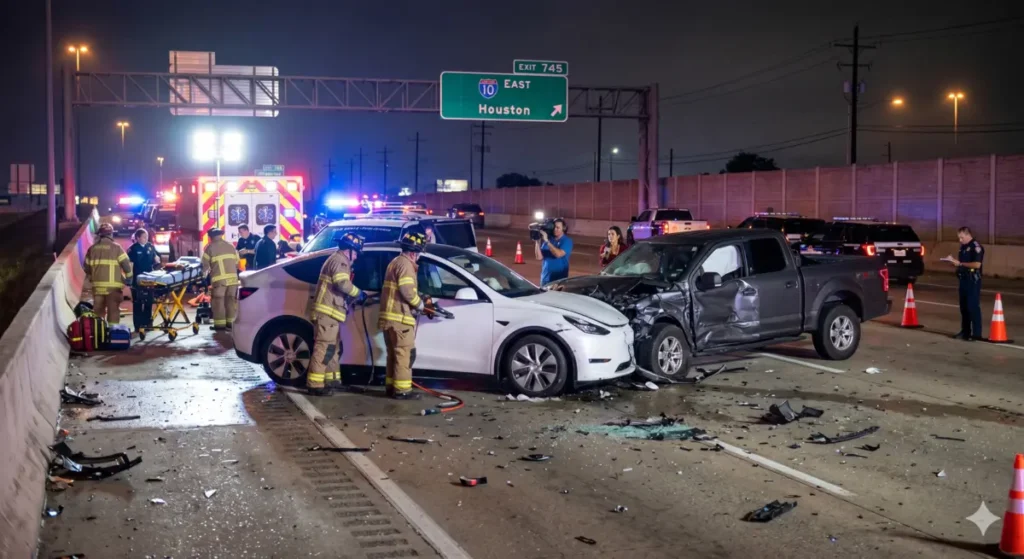
According to the Hays County Sheriff’s Office, the woman was driving southbound on Interstate 35 when her vehicle drifted toward the left shoulder and struck a concrete median barrier at highway speed. Emergency responders arrived within minutes, but the driver was pronounced dead at the scene. The vehicle sustained severe front-end damage, and airbags deployed as designed. Preliminary data retrieved from the vehicle’s onboard computer suggests that Autopilot was engaged in the moments leading up to the impact. Investigators have not yet determined whether the driver’s hands were detected on the steering wheel, which is a requirement for Autopilot operation.
The Investigation
NHTSA’s Special Crash Investigations unit has deployed a team to examine the vehicle and the crash scene. The agency is looking at the behavior of Autopilot in the moments before the crash, including whether the system detected the concrete barrier, how much time the system gave the driver to react, and whether any warnings were issued. Tesla has not issued a public statement specifically about this incident, but it has cooperated with investigators by providing vehicle logs. Texas law enforcement is also reviewing traffic camera footage and interviewing potential witnesses. A preliminary report is expected within the next 30 days.
Industry and Public Reaction
Safety advocacy groups have responded with renewed urgency. The Center for Auto Safety called on NHTSA to issue a moratorium on the use of Autopilot on highways until stronger safeguards are enforced. On social media, reactions have been mixed — some drivers shared personal stories of near-misses with Autopilot, while others defended the system, noting that human error causes the overwhelming majority of crashes. Several U.S. senators have also weighed in, with some calling for a hearing on autonomous vehicle regulation later this summer. The Tesla autopilot crash 2026 has become a flashpoint in the broader conversation about how quickly technology is outpacing regulation.
Key Points
- A 42-year-old woman died on June 14, 2026, after her Tesla Model Y crashed into a concrete barrier on I-35 near San Marcos, Texas.
- Preliminary data indicates that Tesla’s Autopilot system was active at the time of the collision, according to law enforcement.
- NHTSA has launched a formal investigation to determine whether the system functioned as intended and whether driver monitoring was adequate.
- This incident is the latest among dozens of investigations into Tesla’s driver-assistance systems dating back to 2016.
- Safety advocates and lawmakers are calling for stronger federal regulations and clearer communication about the limits of semi-autonomous driving features.
Impact & Analysis
The consequences of this crash are likely to unfold on multiple fronts. In the short term, NHTSA could issue a further recall or a formal enforcement action against Tesla if the investigation uncovers a pattern of failure. Tesla’s stock, which has already faced pressure this year amid slowing EV demand, may see additional volatility depending on the outcome of the probe. Consumer confidence in Autopilot could also take a hit, especially among prospective Tesla buyers who view the feature as a key selling point.
Longer term, this Tesla autopilot crash 2026 could accelerate legislative efforts to impose stricter requirements on driver-assistance systems. Several bills currently in Congress propose mandatory crash-reporting thresholds and more transparent labeling of autonomous capabilities. The auto industry as a whole may also feel pressure to standardize driver-monitoring technologies, such as infrared cameras that track eye movement and hand placement. For everyday drivers, the key takeaway is clear: even the most advanced driver-assistance systems available today are not a substitute for an attentive human behind the wheel.
People Are Also Asking
Conclusion
The tragic Tesla autopilot crash 2026 on a Texas highway serves as a sobering reminder that driver-assistance technology — while increasingly capable — still requires human vigilance. Investigations by NHTSA and local authorities will take time, but the early evidence points to a system that failed to prevent a preventable collision. For Tesla owners, the message is straightforward: know the limits of your vehicle’s features and stay engaged every time you drive. For regulators and the auto industry, this is another urgent call to close the gap between marketing language and real-world safety. If you found this article informative, please share it with fellow drivers and share your thoughts in the comments below.
This article is for informational purposes only and does not constitute legal, financial, or professional advice. Facts and figures are based on preliminary reports and may be updated as investigations continue.
Sources: NHTSA Preliminary Report (June 2026) · Hays County Sheriff’s Office Public Statement · National Transportation Safety Board records · U.S. Department of Transportation documentation.