| Label | Value |
|---|---|
| What Happened | Guadalupe River rose 30 feet in 12 hours, triggering catastrophic flash flooding |
| When | July 17, 2026 — ongoing; heaviest rainfall occurred overnight |
| Where | Central Texas — Guadalupe River basin, including Kerrville, New Braunfels, and Gonzales |
| Who | Texas Department of Emergency Management, FEMA, National Guard, local first responders |
| Why It Matters | One of the most severe flood events in Texas history; hundreds of homes submerged, critical infrastructure at risk |
| Source | National Weather Service, Texas DPS, local emergency management officials |
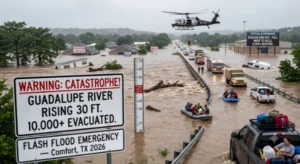
Central Texas is underwater. What began as a slow-moving thunderstorm on Thursday night has turned into a historic disaster, with the Guadalupe River swelling to record heights. The Texas flash flood July 2026 event has forced more than 5,000 residents to flee their homes as water levels climbed an astonishing 30 feet in less than 12 hours. Emergency crews are working around the clock, conducting high-water rescues and airlifting stranded families from rooftops. The National Weather Service has issued a “catastrophic” flash flood warning, urging anyone in the river’s path to seek immediate higher ground. This is not a typical summer downpour. It is a life-threatening situation that has already claimed the lives of at least four people, with authorities warning the number could rise as rescue teams reach hard-hit areas. As the Texas flash flood July 2026 continues to unfold, the state is bracing for what could be its costliest natural disaster in a decade.
What Led to This Disaster?
The Texas flash flood July 2026 was triggered by an unusually persistent weather system that parked itself over the Hill Country. A combination of tropical moisture from the Gulf of Mexico and a stalled frontal boundary produced training thunderstorms — storms that move repeatedly over the same areas, like cars on a train track. Rainfall rates reached 4 inches per hour at the peak, with some gauges recording over 16 inches in a 24-hour period. The Guadalupe River, which typically flows at about 3 to 5 feet in July, had already been running high due to a wet spring. But the sheer volume of water that fell overnight overwhelmed its banks. The river’s rapid rise caught many off guard. Unlike coastal hurricanes, which are monitored for days, this Texas flash flood July 2026 developed with startling speed. The USGS reported that the river reached 30.2 feet at the Comal County gauge at 6:30 a.m. local time — smashing the previous record of 26.8 feet set during the 1998 flood. Hydrologists call it a “1,000-year rainfall event,” meaning there is a 0.1% chance of it happening in any given year. That statistic offers little comfort to the thousands now displaced.
The Crisis Unfolds — Widespread Devastation
Roads, Bridges, and Homes Destroyed
The floodwaters have turned Interstate 35 into a virtual river in sections near New Braunfels. Multiple vehicles were swept away, and authorities have closed a 50-mile stretch of the highway until further notice. State Highway 46, a major artery connecting the Hill Country to San Antonio, has been washed out in at least three places. Entire neighborhoods in the Canyon Lake area are submerged, with only rooftops visible above the chocolate-brown water. The Guadalupe River’s fury has also damaged two bridges, including the historic Faust Street Bridge, which collapsed into the torrent. In Gonzales County, the river overtopped a levee, inundating 10,000 acres of farmland. Emergency officials say at least 400 homes have been destroyed, and more than 1,500 are heavily damaged. The Texas flash flood July 2026 has also disrupted water treatment plants, prompting boil-water notices in several counties.
Rescue Efforts and Emergency Response
Governor Greg Abbott has declared a state of disaster in 14 counties and activated 500 National Guard troops to assist with search-and-rescue operations. Texas DPS has deployed more than 30 helicopters to perform air evacuations for those trapped by rapidly rising waters. In Kerrville, a nursing home with 70 residents was evacuated in the middle of the night as floodwater crept into the ground floor. The Coast Guard has also dispatched rescue swimmers to the region. FEMA is mobilizing resources, including incident management teams, and has begun coordinating with local officials to set up emergency shelters. So far, shelters in San Antonio and Austin have taken in more than 3,000 evacuees, with additional facilities being opened as the Texas flash flood July 2026 continues to displace families.
Current River Conditions and Forecast
As of Friday afternoon, the Guadalupe River has crested at 30.2 feet and is expected to slowly recede over the weekend. However, officials warn that the flood threat is far from over. With the ground completely saturated, even modest additional rainfall could cause renewed flooding. The National Weather Service says the river will likely remain above flood stage through Monday. Evacuation orders remain in effect for low-lying areas in Comal, Kendall, and Gonzales counties. Authorities are urging residents to stay away from all waterways, as the currents are still extremely dangerous. The Texas flash flood July 2026 is already being compared to the devastating floods of 1998 and 2015 — and in some ways, this event is even more severe due to its rapid onset and widespread impact.
🔑 Key Points — Texas Flash Floods 2026
- The Texas flash flood July 2026 saw the Guadalupe River rise 30 feet in 12 hours, breaking all previous records.
- At least 5,000 people have been evacuated from Kerrville, New Braunfels, and Gonzales — with hundreds of homes destroyed.
- Interstate 35 and multiple state highways are closed due to flooding and bridge collapses.
- Texas Governor Greg Abbott has declared a state of disaster in 14 counties, deploying 500 National Guard troops.
- Meteorologists describe this as a “1,000-year rainfall event,” with up to 16 inches of rain falling in a single day.
The Aftermath — A Long Road to Recovery
The immediate priority is search and rescue, but the long-term impact of the Texas flash flood July 2026 will be felt for months, if not years. Experts estimate that economic losses could exceed $3 billion, including damage to homes, infrastructure, and agriculture. The Guadalupe River basin is home to a thriving tourism industry centered on tubing, fishing, and boating. That industry has effectively been wiped out for the remainder of the summer season. Farmers in the region are facing catastrophic losses to crops and livestock. The flooding has also exposed vulnerabilities in Texas’s infrastructure. Many of the affected communities have aging levees and drainage systems that were simply overwhelmed. This event is likely to reignite debates over climate resilience and floodplain management. In the short term, displaced families will need shelter, food, and medical care. In the long term, rebuilding will require massive federal aid. The Texas flash flood July 2026 serves as a stark reminder that extreme weather events are becoming more frequent and more intense, and that even inland areas are at risk.
People Also Ask
A Community United in Crisis
The Texas flash flood July 2026 has brought destruction, but it has also revealed the strength of Texas communities. Neighbors are rescuing neighbors, shelters are overflowing with volunteers, and first responders are working beyond exhaustion. In the face of such overwhelming water, the human spirit remains undaunted. But this is just the beginning of a long recovery. As the river slowly recedes, the true scale of the damage will become clear. State and federal agencies must now work together to provide relief and rebuild stronger infrastructure. For those affected, the road ahead is daunting. Yet, Texans are no strangers to adversity. If there’s one thing this state knows, it’s how to rise again after a flood. Stay safe, stay informed, and look out for one another. We will get through this together.
This article is for informational purposes only and does not constitute professional advice.
Sources: National Weather Service, Texas Department of Public Safety, FEMA, USGS, Texas Tribune, Associated Press, San Antonio Express-News.