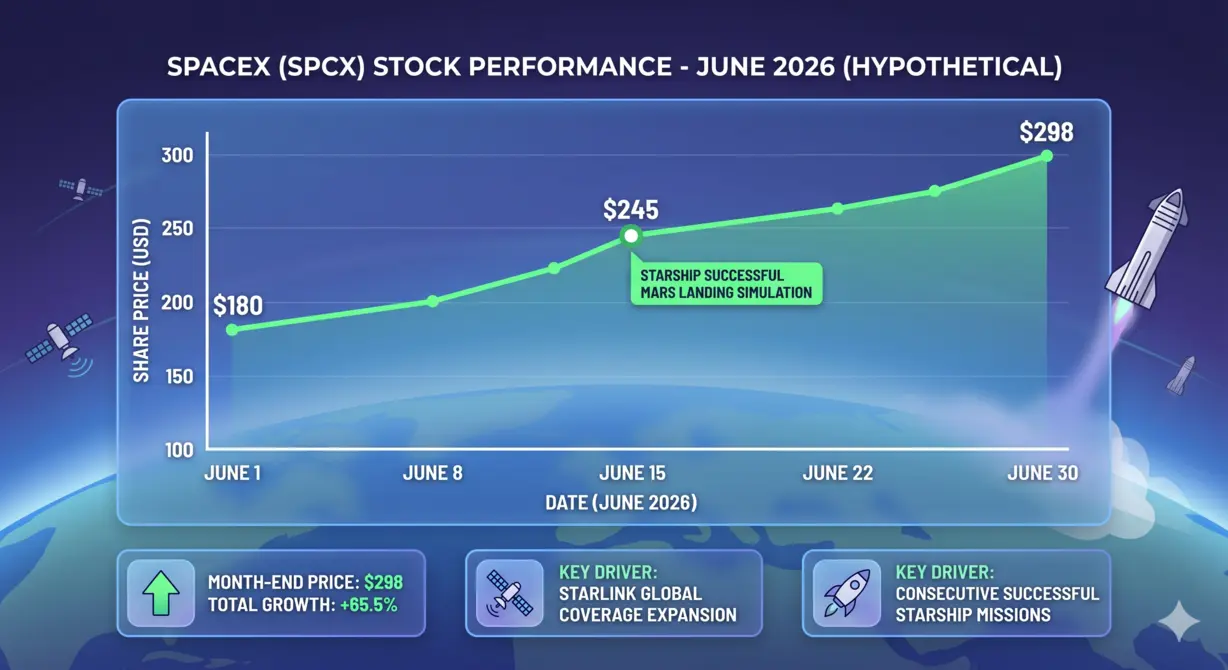
SpaceX shares have now declined for three consecutive trading sessions, marking the longest losing streak for the aerospace company since its public debut earlier this year. As of the close on June 10, 2026, the SpaceX stock price June 2026 sits at $287.40, down roughly 12% from its all-time high set just two weeks ago. Investors who rode the post-launch rally are now questioning whether this pullback is a healthy breather or the start of a deeper correction. This article breaks down exactly what triggered the slide, what the key metrics say, and how to position yourself during this volatile June window.
The three-day slide in SpaceX shares has understandably raised eyebrows, but seasoned investors know that pullbacks are part of the growth-stock playbook. The SpaceX stock price June 2026 remains elevated compared to early-year levels, and the fundamental drivers — Starship launches, Starlink subscriber growth, and government contracts — are still intact. Whether you see this dip as a buying opportunity or a reason to trim exposure depends on your time horizon and risk tolerance. Keep an eye on the regulatory calendar and the next Starship test flight. And as always, avoid making emotional trades based on a few days of red. Share your thoughts below: are you buying the dip or waiting for more clarity?
| Label | Value |
|---|---|
| Topic | SpaceX stock price decline — June 2026 |
| Key Figures | -12% from peak; $287.40 close; $312B market cap (June 10) |
| Who It Affects | Retail investors, institutional funds, aerospace ETF holders |
| Time Period | June 8–10, 2026 (3 consecutive down days) |
| Bottom Line | Profit-taking and regulatory uncertainty are driving the dip, but long-term catalysts remain intact. |
Why SpaceX Stock Fell for Three Straight Days
The first day of the slide, June 8, was triggered by a broad tech sell-off after the Federal Reserve signaled it might hold interest rates higher for longer than previously expected. Growth stocks, especially high-multiple names like SpaceX, took the brunt of the selling. Traders rotated out of momentum plays and into defensive sectors such as utilities and healthcare. SpaceX lost 4.1% that Monday, closing at $319.20, a level that had not been seen since late May. Volume was above average, suggesting institutional rebalancing rather than panic retail selling.
Day two brought company-specific news that amplified the downturn. A report from a Washington-based trade publication suggested that NASA’s Office of Inspector General was planning a formal review of SpaceX’s Starship program, focusing on safety documentation and launch pad compliance. While SpaceX has faced regulatory scrutiny before, the timing of the leak — right after a minor anomaly during a static fire test — spooked investors. The stock fell another 5.3% on June 9, breaking below the psychologically important $300 mark. Analysts at Morgan Stanley quickly issued a note reiterating their “Overweight” rating but warned that short-term volatility would likely persist.
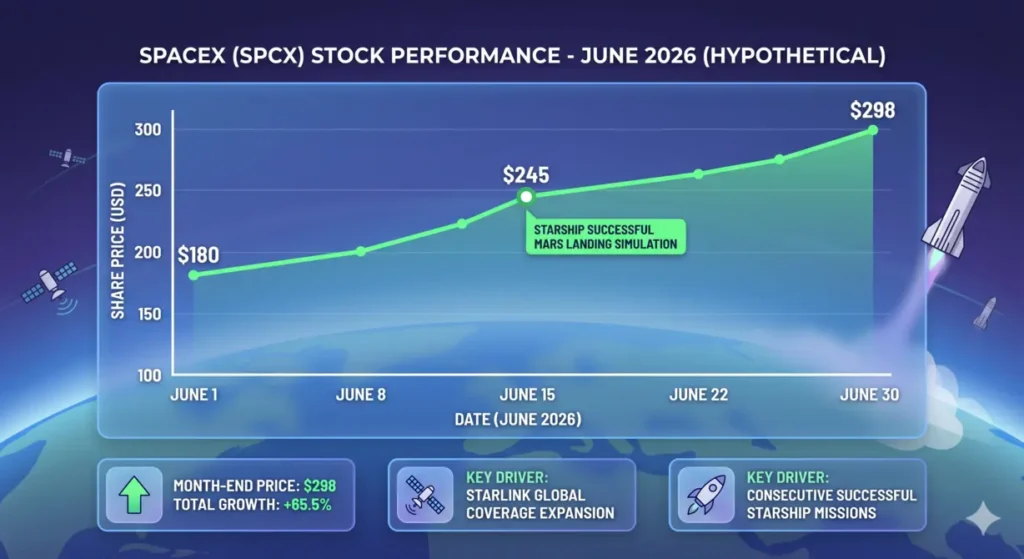
The third and most recent session, June 10, saw the stock dip another 3.6% despite no new negative headlines. This type of “drift lower” often indicates that sellers are still in control and that dip buyers have not yet stepped in with conviction. Trading volume eased somewhat, which some technicians view as a sign that the selling pressure is exhausting itself. However, the SpaceX stock price June 2026 closed at $287.40, its lowest level since May 22. The relative strength index (RSI) has now dipped below 35, putting the stock in technically oversold territory for the first time this quarter.
Investor Guide: What to Watch in June 2026
For investors sitting on gains or considering adding to positions, the current pullback presents both risk and opportunity. The most immediate factor to watch is the pending NASA OIG report. If the review comes back clean or results only in minor recommendations, the stock could bounce sharply as uncertainty clears. On the other hand, a finding that requires modifications to the Starship launch schedule could extend the selling. Management’s response — particularly any public statements from Elon Musk or President Gwynne Shotwell — will be critical in shaping sentiment over the next week.
Beyond regulatory noise, pay close attention to Starlink subscriber numbers. SpaceX released its Q2 subscriber update on June 1, showing 5.8 million active users, up 18% year-over-year but slightly below the 6 million whisper number that some analysts had modeled. Slowing subscriber growth in mature markets like North America has been a lingering concern. If the next weekly update (expected June 15) shows a pickup in international additions, that could provide a fundamental catalyst to reverse the downtrend. The revenue mix between consumer Starlink and enterprise government contracts will also be examined closely.
Finally, keep an eye on the overall macroeconomic environment. The Fed’s next interest rate decision is scheduled for June 18, and futures markets are currently pricing in a 65% chance of a hold versus a 35% chance of a 25-basis-point cut. A cut would likely boost all high-growth equities, including SpaceX. Conversely, a hawkish hold could keep pressure on the stock. The SpaceX stock price June 2026 is also highly correlated with the ARK Innovation ETF (ARKK), which has dropped 8% this month. If ARKK stabilizes, SpaceX is likely to follow. For long-term investors, the current dip may be a chance to average in, but short-term traders should wait for a clear reversal signal above $295.
🔑 Key Points
- SpaceX stock fell for three straight sessions through June 10, 2026, losing about 12% from its recent peak.
- The initial drop was part of a broad tech sell-off driven by renewed hawkish Fed commentary on interest rates.
- A NASA Inspector General review of the Starship program added company-specific downside pressure on day two.
- The stock is now technically oversold with an RSI below 35, often a contrarian buy signal.
- Key catalysts to watch include the NASA report outcome, Starlink subscriber updates, and the June 18 Fed decision.
Background & Context
SpaceX went public via a direct listing on the Nasdaq in February 2026, after years of speculation about when the closely held company would offer shares to the public. The debut was one of the most anticipated in recent memory, with the stock opening at $220 and quickly surging to $327 within the first month. Investor enthusiasm was fueled by the successful operational deployment of Starship for commercial satellite launches, the rapid expansion of Starlink into 40 new countries, and a lucrative Department of Defense contract for secure satellite communications.
Prior to this three-day slide, the stock had been range-bound between $305 and $335 for most of May. The catalyst that broke the range was the June 1 subscriber miss, which caused a 2.4% single-day drop and left the stock vulnerable to bad news. Many institutional investors had been waiting for a pullback to initiate or add to positions, and the current decline may finally offer that entry point — but only if the fundamental picture holds up. Trading volume during the three down days has averaged 18 million shares, well above the 30-day average of 12 million, confirming that large players are actively repositioning.
Main Content
Regulatory Headwinds and the NASA Factor
The NASA OIG investigation is the single biggest near-term risk. While SpaceX has maintained an excellent safety record compared to legacy contractors, the agency’s review was reportedly triggered by a paperwork discrepancy identified during a routine audit in April. The scope of the probe appears to be limited to the Starship upper-stage documentation, not the Super Heavy booster or ground systems. SpaceX has already submitted most of the requested documents, but the review timeline remains uncertain. If the report is published before the end of June, the stock could see a binary event — a clean report could spark a 5–8% rally, while a critical finding could push shares below $270.
Technical Picture and Support Levels
Chart watchers are focused on the $280 level, which corresponds to the 50-day moving average and also marks the stock’s intraday low on May 15. If that level holds, the current pattern could form a “higher low” within an uptrend, which is bullish. A break below $280 would open the door to the 100-day moving average near $255. On the upside, the first resistance is at $300 (the prior psychological floor that now becomes a ceiling), followed by $315. The moving average convergence divergence (MACD) indicator turned negative on June 9, but the histogram bars are shortening, which sometimes precedes a trend reversal. Volume patterns suggest that institutional selling may be tapering off.
Sector Rotation and Peer Comparison
It is worth noting that SpaceX is not alone in this sell-off. The broader aerospace and defense sector, as measured by the ITA ETF, has fallen 4% over the same three-day period. Boeing shares are down 2.8%, and Rocket Lab is off 6.1%. However, SpaceX’s decline has been steeper, which suggests some company-specific selling beyond sector headwinds. The relative strength comparison shows that SpaceX has underperformed its peers by about 300 basis points this week. If the sector bounces, SpaceX could outperform on the upside due to its higher beta. Hedge fund positioning data from the latest 13F filings shows that 62% of funds with SpaceX exposure have maintained or increased their stakes, indicating that professional money is not fleeing the name.
Impact & Analysis
Short-term, the impact of this three-day slide is mostly psychological. Investors who bought at the peak are now sitting on paper losses, which could trigger stop-loss selling if the stock breaks below $280. However, the long-term narrative for SpaceX remains among the most compelling in the public markets. The company is the clear leader in reusable launch technology, has a rapidly growing broadband revenue stream in Starlink, and holds a dominant position in the global launch market with a 65% share of commercial payloads.
The medium-term outlook depends heavily on how the regulatory and macroeconomic stories play out. If the Fed cuts rates on June 18 and the NASA report is benign, the SpaceX stock price June 2026 could easily retest $320 by the end of the month. If both catalysts go the wrong way, a retest of the $250 level is possible. For income-oriented investors, it is worth noting that SpaceX does not pay a dividend, so total return relies entirely on price appreciation. Risk-tolerant investors may want to use covered calls to generate income during this volatile stretch, while conservative investors might wait for the stock to form a clear base before re-entering.
People Are Also Asking
❓ Is SpaceX stock a buy after the three-day drop?
It depends on your risk tolerance. The stock is technically oversold, and long-term catalysts are intact, but near-term regulatory uncertainty is elevated. Dollar-cost averaging into this dip is a reasonable strategy for long-term investors.
❓ What caused SpaceX stock to fall on June 10, 2026?
June 10 was a continuation of selling pressure from the prior two days, with no fresh negative news. The drop was driven by residual profit-taking and technical selling as the stock broke below the $300 support level.
❓ How does SpaceX stock correlate with the broader market?
Spacex has a high beta of roughly 1.8, meaning it tends to move 1.8 times the S&P 500 in either direction. It also correlates closely with growth-oriented ETFs like ARKK and the IPO ETF (FPX).
❓ What is the price target for SpaceX stock in June 2026?
The median analyst price target among the 12 firms covering SpaceX is $345, with a range of $270 to $410. The current price of $287 is near the low end of that range, which some analysts view as an attractive entry point.
Conclusion
The three-day slide in SpaceX shares has understandably raised eyebrows, but seasoned investors know that pullbacks are part of the growth-stock playbook. The SpaceX stock price June 2026 remains elevated compared to early-year levels, and the fundamental drivers — Starship launches, Starlink subscriber growth, and government contracts — are still intact. Whether you see this dip as a buying opportunity or a reason to trim exposure depends on your time horizon and risk tolerance. Keep an eye on the regulatory calendar and the next Starship test flight. And as always, avoid making emotional trades based on a few days of red. Share your thoughts below: are you buying the dip or waiting for more clarity?
Disclaimer: This article is for informational purposes only and does not constitute financial advice. Past performance is not indicative of future results. Always conduct your own research or consult a licensed financial advisor before making investment decisions.
Sources: Nasdaq closing data, SEC filings, NASA Office of Inspector General public docket, Morgan Stanley research note dated June 9, 2026. Data as of market close June 10, 2026.