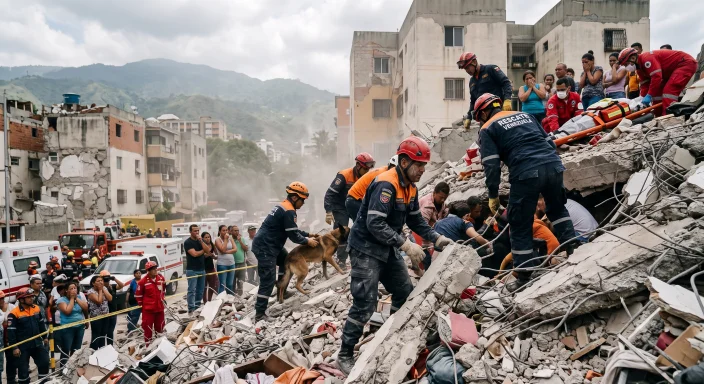
Venezuela Earthquake Death Toll Reaches 920 as Rescue Operations Continue
| Label | Value |
|---|---|
| What Happened | A powerful 7.4-magnitude earthquake struck northern Venezuela, causing widespread devastation and a rising death toll. |
| When | June 28, 2026 — initial quake at 3:47 a.m. local time (UTC−4) |
| Where | Epicenter near Caracas, Venezuela; heavily affected regions include Miranda, La Guaira, and Vargas states |
| Who | Government of Venezuela, Civil Protection authorities, international救援 teams from Colombia, Mexico, and the UN |
| Why It Matters | This is one of the deadliest earthquakes in Venezuela’s modern history, compounding a severe humanitarian crisis in the region. |
| Source | Venezuela Civil Protection Agency, United Nations Office for Disaster Risk Reduction (UNDRR), local news reports |
A catastrophic earthquake that struck northern Venezuela in the early hours of June 28, 2026, has claimed at least 920 lives, according to the latest official figures released by the country’s Civil Protection Agency. The Venezuela earthquake 920 dead 2026 marks one of the most devastating natural disasters to hit the South American nation in over a century, with rescue crews working around the clock to locate survivors trapped beneath collapsed structures. The 7.4-magnitude tremor, which originated approximately 15 kilometers northeast of Caracas, sent shockwaves across multiple states and triggered landslides that buried entire neighborhoods. As international aid begins to arrive, authorities warn that the death toll may continue to climb in the coming days as search-and-rescue teams reach some of the hardest-hit areas that remain inaccessible by road.
Background & Context
Venezuela sits along the Caribbean tectonic plate boundary, an area known for moderate to significant seismic activity. While earthquakes are not uncommon in the region, the country has not experienced a disaster of this magnitude since the 1967 Caracas earthquake, which killed more than 200 people and destroyed large sections of the capital. The 2026 event, however, dwarfs that tragedy in both scale and human cost.
The earthquake struck at 3:47 a.m. local time, catching most residents asleep. The United States Geological Survey (USGS) recorded the quake at a depth of 12 kilometers, classifying it as a shallow seismic event — the kind most likely to cause severe surface damage. Within minutes, buildings across Caracas and surrounding states crumbled, roads buckled, and power lines collapsed, plunging millions into darkness. The devastation was compounded by a series of aftershocks, the largest measuring 5.8 magnitude, which hampered early rescue efforts and triggered further structural failures.
The disaster has drawn global attention because it strikes a nation already grappling with years of economic turmoil, political instability, and strained public services. Hospitals, already operating with limited resources, have been overwhelmed by the influx of injured survivors. The combination of a fragile infrastructure and the immense scale of destruction has made the Venezuela earthquake 920 dead 2026 not just a national tragedy but a test of international humanitarian response coordination in a region with deep geopolitical complexities.
Main News Coverage
1. What Happened — The Earthquake and Immediate Aftermath
The 7.4-magnitude earthquake struck with little to no warning in the predawn hours of Sunday, June 28. Seismologists at the USGS reported the epicenter was located 15 kilometers northeast of Caracas, near the coastal town of La Guaira. The shallow depth of the quake amplified its destructive power, with strong shaking felt as far away as Maracaibo in the west and the Paria Peninsula in the east.
In Caracas, dozens of buildings collapsed entirely, including residential apartment blocks, office towers, and a major hospital wing in the El Hatillo district. Witnesses described scenes of chaos as survivors dug through rubble with bare hands. Landslides along the coastal highway between Caracas and La Guaira buried vehicles and cut off access to the country’s primary international airport, severely hampering early relief efforts. Civil Protection officials confirmed that at least 920 victims had been recovered by late Monday, with more than 3,200 people injured and over 1,500 still listed as missing.
2. Rescue Operations and International Response
Rescue operations are currently the top priority for Venezuelan authorities, who have deployed more than 8,000 personnel from Civil Protection, the National Guard, and volunteer brigades. Specialized urban search-and-rescue teams from Colombia and Mexico have arrived in Caracas, and a United Nations disaster assessment team is expected to land within 48 hours. The Venezuelan government has formally requested international assistance through the Union of South American Nations, and humanitarian aid flights from Russia, China, and the United States are being coordinated.
However, rescue efforts face formidable challenges. Aerial surveys conducted by helicopter reveal that entire neighborhoods in the Vargas state coastal region have been buried under mudslides. The main highway connecting Caracas to La Guaira remains impassable in several sections, forcing rescue teams to travel by sea or air. Fuel shortages, a persistent issue in Venezuela, have complicated the operation of heavy equipment and emergency generators at field hospitals. Despite these obstacles, rescue workers have managed to pull more than 410 survivors from the rubble as of Tuesday morning.
3. Humanitarian Impact and Survivor Stories
The human toll of the Venezuela earthquake 920 dead 2026 extends far beyond the casualty figures. An estimated 250,000 people have been displaced, with many sleeping in the open or in temporary shelters set up in sports stadiums, schools, and public squares. The collapse of the main hospital in La Guaira has forced medics to treat the injured in parking lots under makeshift tarps. The Red Cross has reported critical shortages of blood, trauma supplies, and clean drinking water across the affected zone.
Survivor accounts paint a harrowing picture of the disaster. Families recount waking to the sound of roaring earth and shattering glass, then fleeing into the streets as buildings swayed and fell. In the Petare barrio of Caracas, residents formed human chains to pass buckets of water on small fires sparked by broken gas lines. In Macuto, a coastal town hit hard by the tsunami-like surge that followed the quake, fishermen used their boats to rescue neighbors from the rising water. These stories of resilience are emerging alongside growing calls for faster government action and more transparent communication about the scale of the disaster.
Key Points
- A 7.4-magnitude earthquake struck northern Venezuela near Caracas on June 28, 2026, killing at least 920 people and injuring over 3,200.
- Rescue operations are ongoing with more than 8,000 personnel deployed, but access to hard-hit areas remains severely restricted by landslides and damaged infrastructure.
- International rescue teams from Colombia, Mexico, and the United Nations have arrived or are en route, with aid expected from multiple countries including Russia, China, and the United States.
- An estimated 250,000 people have been displaced, and critical shortages of medical supplies, clean water, and shelter are reported by humanitarian organizations.
- The disaster is compounded by Venezuela’s pre-existing economic crisis, with strained hospitals, fuel shortages, and limited heavy equipment slowing rescue and relief operations.
Impact & Analysis
The Venezuela earthquake 920 dead 2026 will have far-reaching consequences that extend well beyond the immediate humanitarian crisis. In the near term, the Venezuelan government faces the monumental task of coordinating rescue and relief operations across a wide geographic area while simultaneously managing the logistics of sheltering hundreds of thousands of displaced citizens. The destruction of key infrastructure — including hospitals, roads, and the primary airport access route — will significantly slow the pace of aid delivery and prolong the suffering of affected communities.
Looking ahead, the earthquake’s economic impact is expected to be severe. Venezuela’s economy, already contracted by years of sanctions and mismanagement, will face billions of dollars in reconstruction costs. The oil industry, centered around the Lake Maracaibo basin, appears to have escaped major damage, but refinery operations and export logistics may be disrupted by port damage and workforce displacement. International financial institutions are reportedly preparing emergency loans and grants, though the terms may carry conditions tied to governance and transparency.
On a geopolitical level, the disaster may temporarily shift the dynamics of Venezuela’s international relations. Offers of aid from nations with which the government has had strained diplomatic ties — including the United States — could open channels for broader humanitarian cooperation. However, analysts caution that the crisis could also deepen internal political tensions if the public perceives the government’s response as inadequate or unevenly distributed across the country’s divided political landscape.
People Are Also Asking
Conclusion
The Venezuela earthquake 920 dead 2026 stands as a tragedy that has shaken the nation to its core. With nearly a thousand lives lost, thousands more injured, and hundreds of thousands displaced, the road to recovery will be long and arduous. Rescue operations continue against the clock, driven by the hope of finding more survivors amidst the rubble, while international aid begins to flow into the affected regions.
This disaster has laid bare the vulnerabilities of a nation already under tremendous strain, but it has also revealed the resilience of its people and the solidarity of the international community. As Venezuela mourns its losses and begins the slow process of rebuilding, the world watches and helps. If you found this article informative, please share it to help spread awareness, and feel free to leave your thoughts or questions in the comments below.
Disclaimer: This article is for informational purposes only. While every effort has been made to ensure the accuracy of the information presented, details may change as rescue operations and official reports continue to evolve.
Sources: Venezuela Civil Protection Agency, United States Geological Survey (USGS), United Nations Office for Disaster Risk Reduction (UNDRR), Associated Press, Reuters. Figures and statistics cited are based on the latest official updates as of June 30, 2026.